
--- corporate-drones ---
2026.06.16
A Field Guide to Spotting Gatekeepers
Across different industries, different buildings, I keep meeting the same person.
I’ve spent a lot of time lately as a consultant, which is a polite way of saying I get sent into companies full of people who didn’t ask for me, get asked to find out why the thing isn’t working, and then sent back out again once they are finished with me. And after a few years I’ve started to get a strange feeling, which is that I keep meeting the same person. Really, I had this creeping suspicion even when I was working W-2 jobs, but now I’ve gathered enough evidence to feel like it’s categorically true. Across different industries, different buildings, wearing different pages, I keep meeting the same person, again and again, and always, without exception, they are completely full of shit.
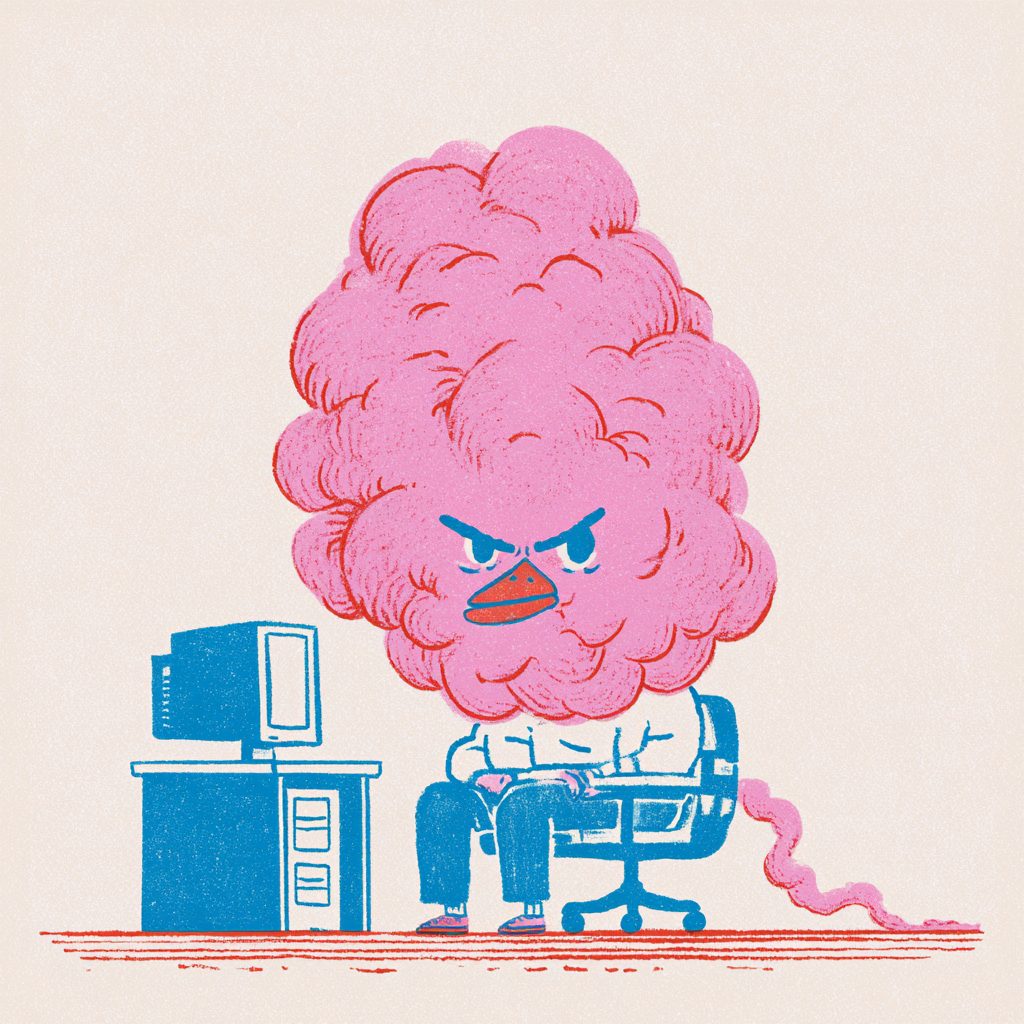
I’ve met this person in hospitals mostly, because that’s where I’ve spent the most time, in and around those strange beige-carpeted back office buildings where the actual medicine is a whisper happening somewhere else (but nearby, just to keep us motivated!) and everyone on this particular floor is instead doing something unspeakable to a spreadsheet.
I’ve also met this person in manufacturing, way out past the plant floor where real things are getting bent and welded into existence, up in the offices where nothing feels real. I’ve met them in finance and HR and payroll and, God help us, the project management office, which is less a department and more a climate-controlled enclosure built specifically for people who are full of shit.
The first thing that clues you in, this person is never the one doing the work. They are the one standing next to the work with a hand resting on it, like someone posing for a photo with a fish that somebody else caught because they just happened to be on the same boat.
Let me introduce you to a few of them.
There was a woman at a health system (I won’t say which) whose entire self was organized around a single reconciliation process. Charge data went in one end and came out the other reconciled, and only she knew how, and she had made very sure of that. There was absolutely zero documentation. None. When I asked her to walk me through the process she looked at me like I’d asked to read her diary, and what I got instead of a straight answer was a forty-five minute tirade of the department’s history, the reorg that happened in 2016, the time the old system went down, three separate people’s names who are apparently very important and she wants to make sure I know that she knows them. I left the meeting knowing less than when I walked in (other than the tea, of course), which I eventually understood is the meeting working exactly as she designed it.

Then there was a man at a parts manufacturer who owned the close. Capital T, capital C, The Close. He’d built a single Excel file thick with undocumented macros and running it had become a monthly séance only he could conduct, hunched and muttering over the computer while the rest of finance waited outside his cubicle like villagers watching the sky. He could’ve written it down. He could’ve turned it into a boring, robust, anyone-can-do-it process. But he’d sooner have died than do that, because the mystery was the job. The job underneath the job, the only one that really mattered to him, was that nobody else could do it.
There was also a project manager (there is always a project manager) who ran a project so beautifully that its status stayed green for fourteen straight months until it simply disappeared one day. Green, green, green, green, dead. He made the most gorgeous decks I have ever laid eyes on. Gradients & little icons & a RAG legend nobody needed because the status was eternally, immovably GREEN. He drove alignment. He socialized the roadmap. He put pins in some things and he parked some things and he took some other things offline, and when it was all over, if you picked the project up and shook it, nothing fell out, because there had never actually been anything inside.

I could keep going. The payroll lead who is the only living soul who understands why the overtime calc has been quietly throwing errors since 2019, and has made that everyone’s problem but her own. The HR person whose entire measurable output is the scheduling of meetings about other meetings. They are everywhere, once your eyes adjust to the blinding light of the corporate world.
The existence of this person kinda runs against the grain of how you’d expect a business to function. If I had to guess, the real work, that is to say the labor the whole company is secretly standing on, is being carried by something like one in seven people, at best. On a bad team, more like one in ten or one in fifteen. The other six or nine or fourteen or whatever aren’t all conniving monsters, I’m not saying that. Most of them are just drifting along, doing their gentle little orbit around the small dense core of people who keep the lights on. They seem to be lazily content with doing the bare minimum. Some of them are violently addicted to social media or are busy shopping on Amazon and avoiding all responsibility by any means necessary. Some of them are just fully checked out, doing personal errands and going on hikes and installing mouse-jigglers to keep their Teams “available”.
Then there are the GATEKEEPERS, and they are such treacherous little creatures. Shockingly enough, they work their asses off, they are not lazy at all. They just work their asses off at building gates instead of at doing their job. And that’s the person I started this essay talking about. For the gatekeeper, it’s not about laziness. Laziness is honest, almost cute by comparison. The gatekeeper’s move is to take something that ought to be a flat open field anyone can stroll across (i.e. your data, your process, your access, your dumb little stretch of how the company actually works) and quietly build a fence around it and put up a tollbooth. Except you can’t actually pay anything to get through the tollbooth because the accepted currency keeps changing, or because the tollbooth is closed since it’s raining outside, or because the coin machine is miraculously broken again. And so the company fills up, year by year, with more gates and fewer fields, until one day you’re walking down a corridor that is nothing but locked doors with a person posted in front of every one of them, explaining at length about how what’s behind it is more complicated than it looks.

I want to be clear I don’t think this is some modern disease and it’s not novel human behavior. I think it’s likely that the oldest part of people, the scared animal in the back of the skull, worked out a very long time ago that if you’re the only one who knows where the water is, you are very important. So, keep the scripture in Latin! Keep the recipe in your head! Make the magic look like magic so nobody asks you to turn over your hands. We’ve been doing this since we lived in caves, probably.
That said, I do think there’s been a shift in the last couple decades. We’ve effectively handed everyone an unlimited supply of gate-building material. Gates used to be expensive and you needed real, rare knowledge to put one up, some scarce skill of your own. Now there are platforms and dashboards and “knowledge layers” and sixteen overlapping systems that each demand their own high priest’s blessing, and then there’s AI sitting on top of the whole pile generating complexity faster than any human alive could ever read it. The gatekeeper has never been more content, because now it can throw up a gate in an afternoon and call it digital transformation.
The bloat is compounding! We built a machine that prints gates almost for free and then handed the keys to people who were always going to abuse them.
In all these years I’ve worked with very few teams that didn’t have this problem. Those teams simply never let the gatekeeping take root. They were almost always small, and almost always run by one or two people who were visibly, undramatically good at the actual work, and who treated hidden processes the way you’d treat a gas leak. As soon as somebody started building a little moat, started going “oh, that one’s complicated, let me just handle it,” instead of being impressed the whole team would turn and look at them like, no. Write it down. Show your work. There are no wizards here.
It is the least mysterious, least glamorous, most boring kind of competence. Everything is documented, everything is dull and open and shared, and yet it is the most functional thing I have ever witnessed. To see it almost makes me emotional, which is embarrassing and I would rather you didn’t repeat that.
And look, let me dismount my high horse. I feel the pull too. I think everyone feels the urge to be the one who knows the thing the client/customer doesn’t, to be a little bit indispensable, to fog up a simple answer just enough that they keep paying you to wipe it clean again. I just try to intentionally kill that impulse, most days, which is the closest thing to being a decent person I have ever reliably pulled off.
So next time you feel the gate going up inside you, make yourself leave the door open instead. And then do it again and again. Eventually you’ll transcend the very human inclination to gatekeep and now you’re doing the real work, you’re contributing to a sustainable working environment! Of course, nobody wants to do that because it is quite boring, it makes you replaceable, and it does not feel anything at all like power. But it will make you feel better about yourself, so I suppose that’s a plus. And there’s the karma, if you believe in that sort of thing…
In any case, there’s a gatekeeper in your building too. You already know exactly who it is. You’ve known for years. It’s the one who’s going to read this and forward it to the whole team with a note about how true it is.
also on Medium